

Overview
- Who should be assigned elevated access rights?
- How should we ensure robust access control?
- What are the best solutions available to ensure identity and access security?
- Are the right people having access to the rights systems at the right time?
- Are there adequate IT policies in place?
These are some of the critical questions that dominate IT heads’ discussions. In the era of digitalisation,
industrial automation, organizations adopt technologies like AI/ ML, Cloud Computing (IaaS and SaaS models), RPA et al. to stay at par with rapid transformation.
Subsequently, it has resulted in an urgent need for having a set of well-defined rules and regulations around access controls and IT activities, in general. The reason being that today’s complex data center environment has led to uncontrolled rise in the number of end-users.
These end-users are expected to perform baseline IT activities according to the configured policies; however, if they deviate from it, an IT incident is always a possibility. Therefore it is imperative to seamlessly manage and monitor the daily activities of end-users. But to ensure that, it is important to have people, processes and technologies in place.
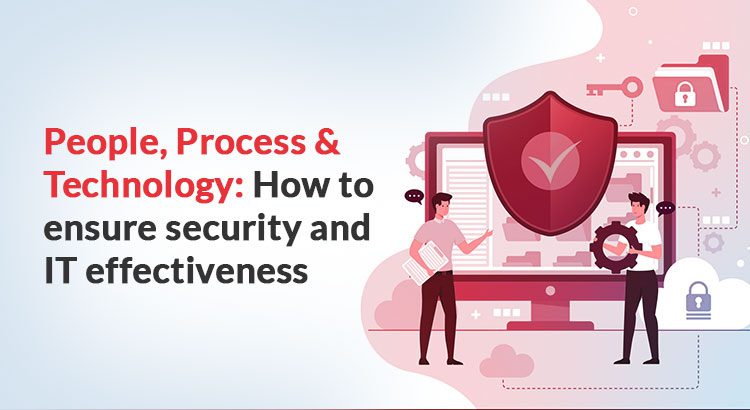
Let us delve deep into the three key factors for IT security and effectiveness.
People
The robustness of IT security in an enterprise to a large extent depends on the people of the organization. To ensure a robust data center, an organization must have multi-layered IT security teams.
| Department | Sub-Department |
| IT Risk Management Team | IT Risk Assessment Team
Zero-Risk Assurance Team |
| IT Security Team | IT security policy enforcement team
IT security training team |
| IT Audit Team | IT Pre-Audit Team
IT Post-Audit Team |
The people – IT Security teams, ensure that the cybersecurity policies of the organizations are strictly followed throughout. When there is an unambiguous list of “do’s and don’ts”, chances of cyber attacks decrease significantly.
Moreover, employees are kept abreast of the latest developments. They are trained with new IT security practices in regular intervals so that they are aware of the precautionary measures. With regular IT audits, IT security shortcomings are highlighted before any untoward incidents happen.
Process
After identifying people to streamline the IT activities, the next step is to have a set of well-defined processes.
It is imperative to have unambiguous guidelines as to who will access what (systems)? How will it be accessed (validation method), when it will be accessed? When to give an end-user elevated rights to systems? When there are hundreds (or maybe thousands) of people are responsible for managing the overall IT operations of an enterprise, it becomes critical for the organizations to start tracking their activities.
At the same time, it is critical that key processes and IT workflow matrix is in place to eliminate ambiguity around IT processes. From an identity and access management point of view, a few examples include: authorization policy, access policy, password policy, privileged elevation and restrictions policies etc.
Technologies
Once organizations have well-defined policies as to people and processes the next step is to identify critical technologies to ensure data integrity. From an identity and access control point of view, the following technologies developed by ARCON can help fill the security gaps.
Privileged Access Management (PAM): This robust solution enables IT security and risk management teams to have a rule and role-based contextual access control around privileged users and systems. All the people (privileged users), procedures, processes as to privileged tasks can be enforced using a unified access control engine.
Moreover, PAM solution meets the rising demand for Single-Sign-On, real-time monitoring and user restrictions capabilities in case of secured remote access. The privileged users are allowed to access the target systems strictly on a ‘need-to-know’ and ‘need-to-do’ basis along with an audit of every privileged session.
User Behaviour Analytics (UBA): This solution helps organizations to overcome any kind of ambiguity over end-users’ trust by constantly monitoring endpoints. With the help of real-time threat detection capability, this solution enables the security team to find out end-users that deviate from baseline activities. In other words UBA enables the security team to configure baseline activities as per end-users’ roles and responsibilities. It helps in securing business-critical applications.The end-user access is granted with “Just-in-time Privilege” policy to restrict the duration of the activities on applications which in turn improves the overall access control mechanism.
Security Compliance Management: This is an automated vulnerability assessment tool that enables an organization to conduct real-time assessment of baseline security configurations. It is effective for all technology platforms where security vulnerabilities arise from unauthorized end-users and unmonitored devices, applications or systems in an IT environment.
The Bottom Line:
People, Process and Technology are the three pillars for building a robust IT security posture. Vulnerabilities in any of the pillars can demolish the entire IT construction. A well-trained IT security team following a well-defined IT process and policy can ensure data integrity. Once the relevant and appropriate technologies are adopted and incorporated in the IT environment, the overall IT security turns effective.